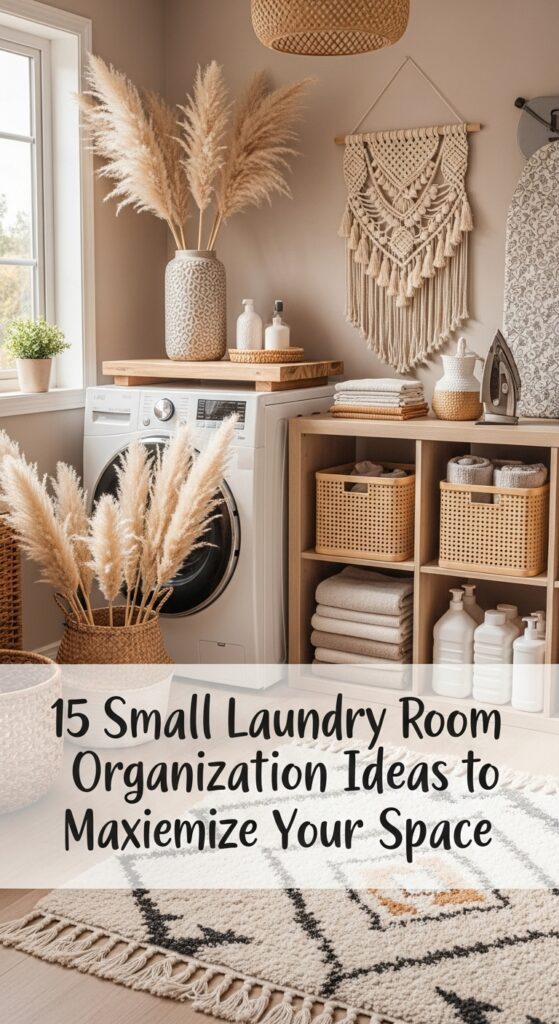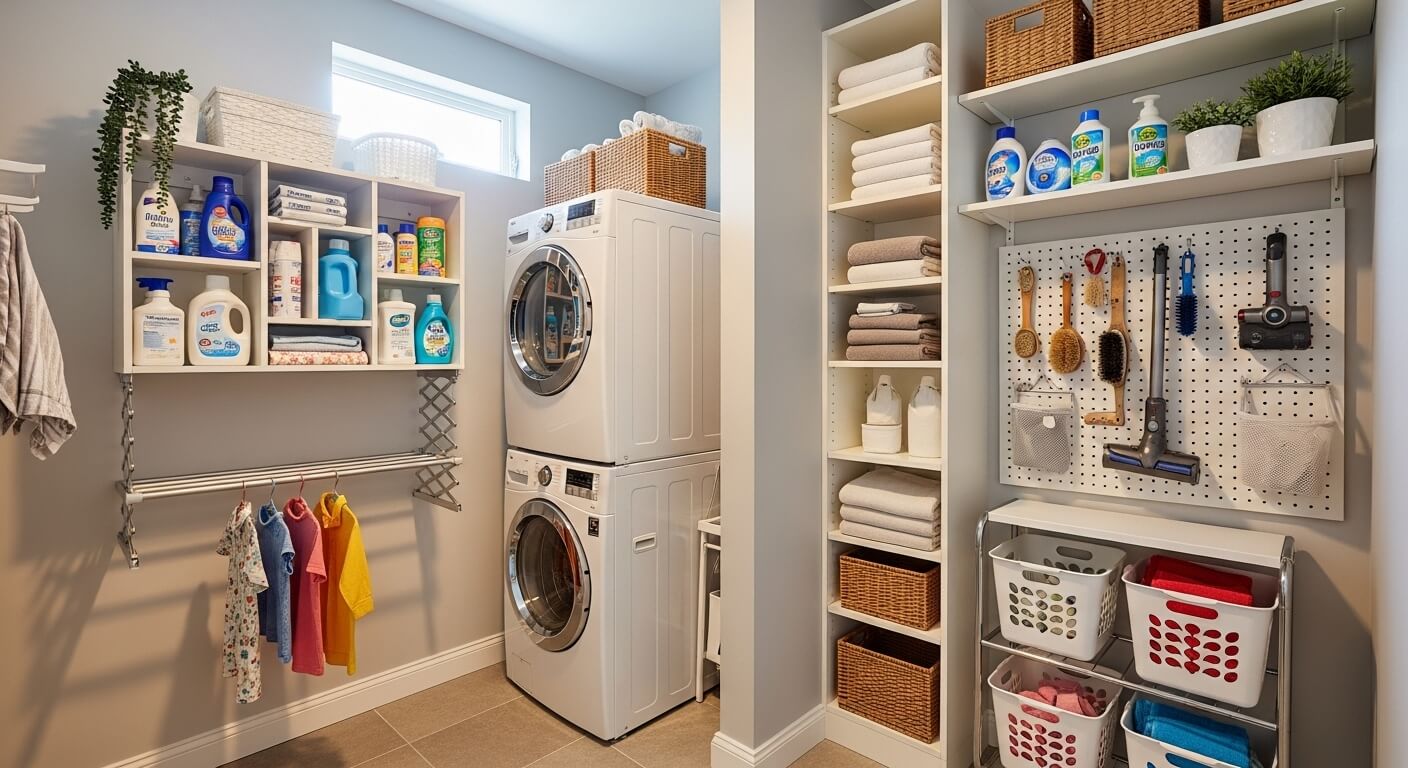
A small laundry room can quickly become cluttered when detergent bottles, laundry baskets, cleaning supplies, and clothes compete for limited space. Even a room with enough space for a washer and dryer can feel cramped without an effective storage system.
Fortunately, you don’t need a complete renovation to create a more organized laundry area. With a few clever storage solutions and thoughtful layout changes, you can make better use of your walls, corners, doors, and available floor space.
These 15 small laundry room organization ideas will help you create a functional, tidy, and attractive space. Whether you have a narrow laundry closet, a compact utility room, or a small laundry area tucked into another room, you’ll find practical ways to keep everything accessible without overcrowding the space.
1. Maximize Vertical Space With Wall Shelves and Cabinets
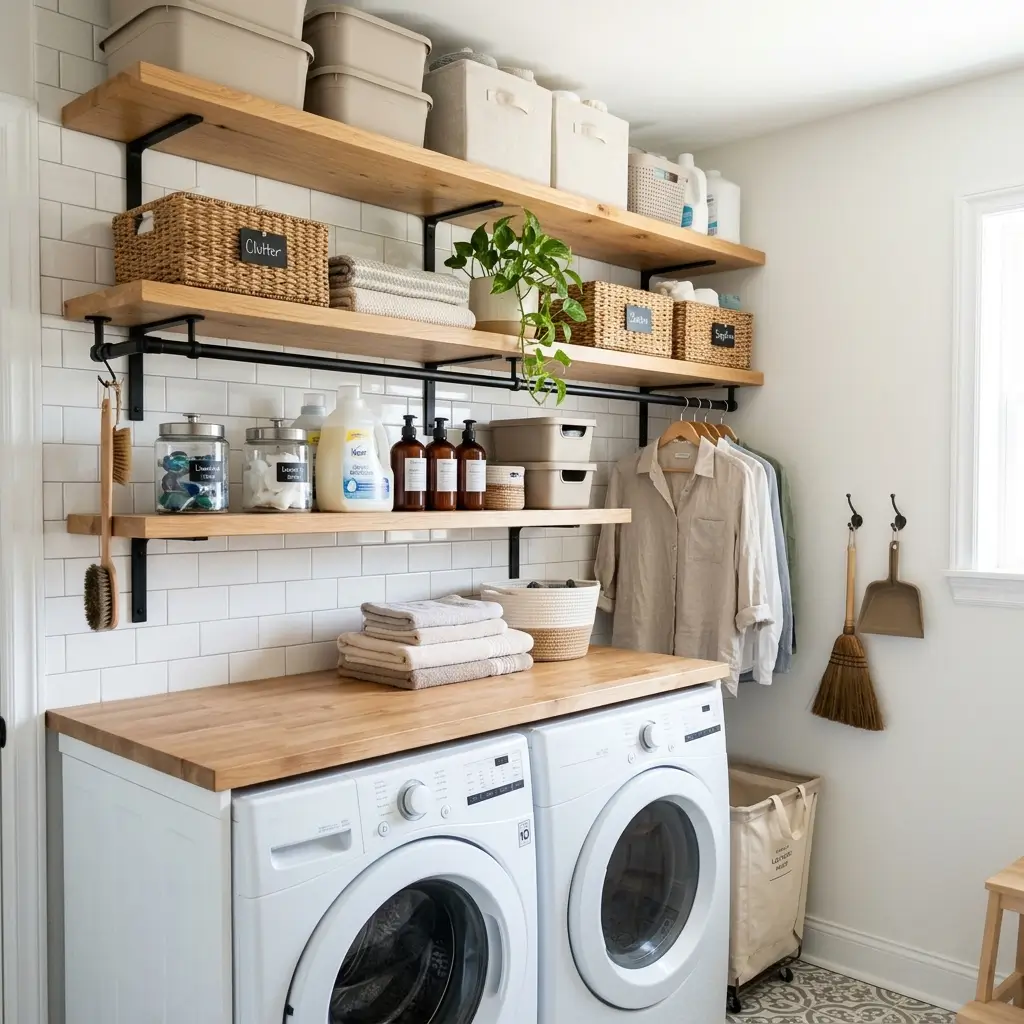
When floor space is limited, look upward. Installing shelves or cabinets above your washer and dryer creates additional storage without taking up valuable walking space.
Use upper shelves for laundry baskets, folded towels, spare supplies, and other items you don’t need every day. Keep frequently used products on an accessible shelf or in a cabinet at a comfortable height.
For a more organized appearance, combine closed cabinets with a few open shelves. Cabinets conceal less attractive supplies, while open shelving provides convenient access to everyday essentials.
How to make it work:
- Measure the available wall space before purchasing shelves.
- Choose moisture-resistant materials suitable for your laundry environment.
- Use sturdy brackets and appropriate wall fixings.
- Keep heavy items on lower shelves.
- Avoid blocking appliance controls, vents, or access panels.
Space-saving tip: Install two or three shelves in a narrow vertical arrangement rather than filling the room with bulky floor-standing cabinets.

2. Install a Fold-Down Drying Rack
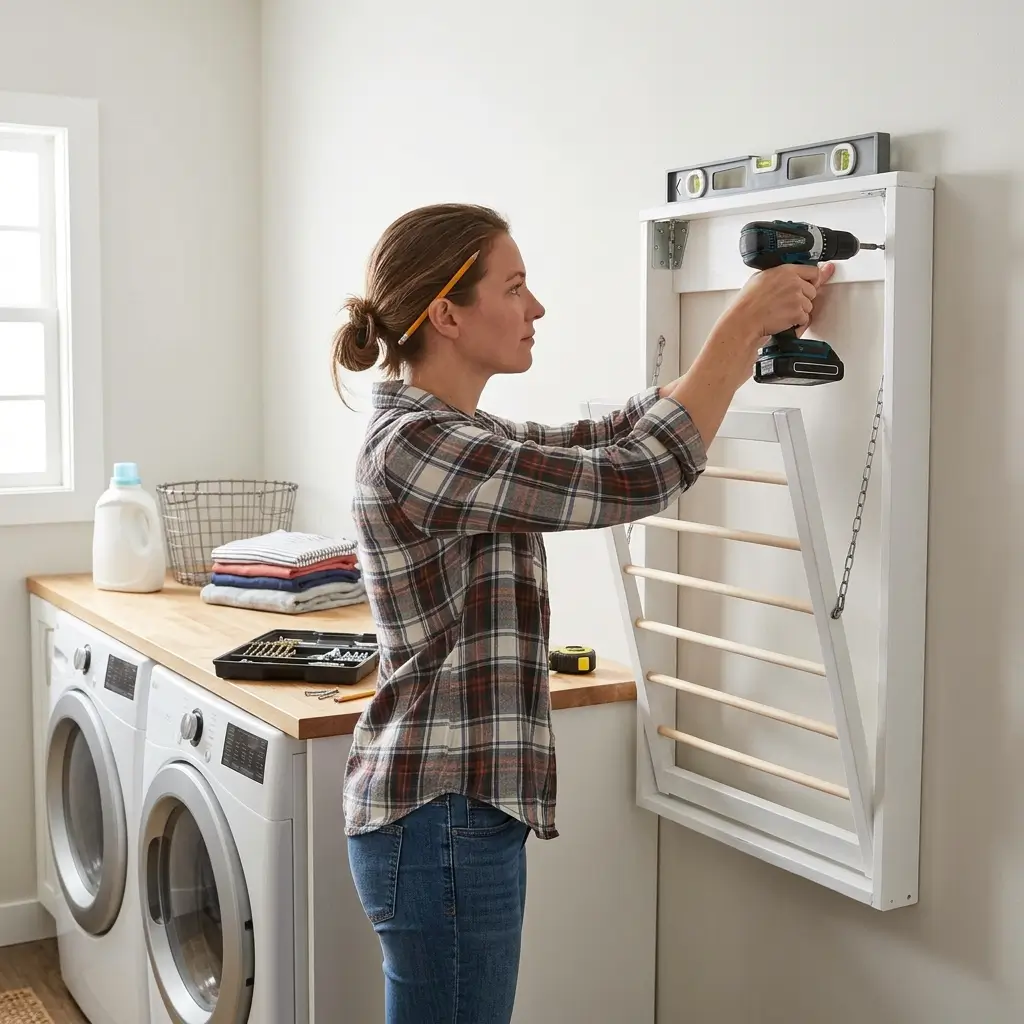
A traditional drying rack can occupy considerable floor space, particularly in a small laundry room. A wall-mounted fold-down drying rack provides a convenient alternative.
When you need to dry delicate clothing, workout clothes, or hand-washed items, simply lower the rack. Once the clothes are dry, fold it back against the wall.
Some models have multiple rails, while others feature a compact accordion-style design. Choose one that suits the amount of laundry you typically air-dry.
How to make it work:
- Position the rack where clothes can hang without obstructing the washer or dryer.
- Check the rack’s weight capacity before installation.
- Attach it to suitable wall supports using the manufacturer’s recommended fixings.
- Allow enough space for clothes to hang freely.
Space-saving tip: Install the rack above a laundry hamper or beside the washer to use otherwise underutilized wall space.
3. Add Wall Hooks for Everyday Laundry Essentials
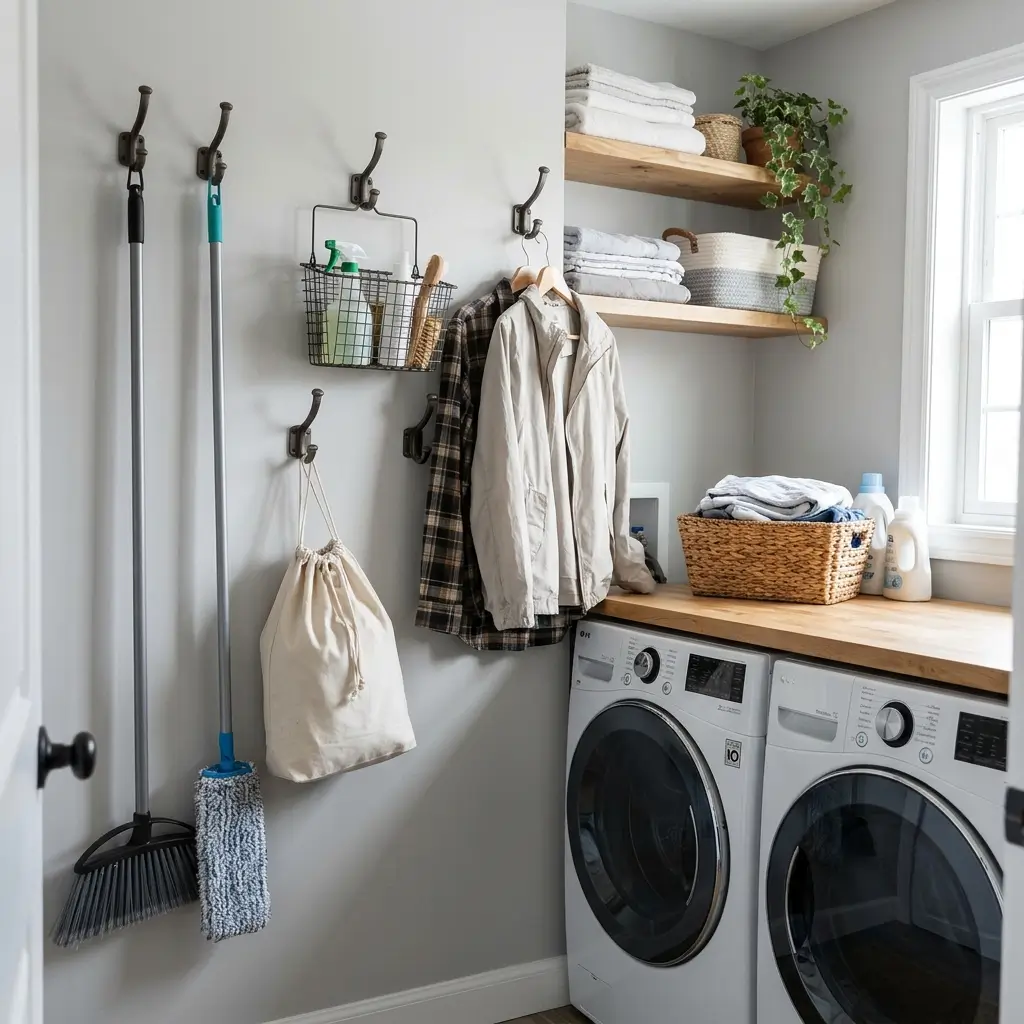
Wall hooks are among the simplest and most affordable small laundry room storage solutions. They provide convenient places to hang items that would otherwise end up on the floor or countertops.
Use hooks for laundry bags, reusable shopping bags, cleaning cloths, lint brushes, and lightweight garments awaiting ironing.
You can also install a row of hooks near the entrance to keep frequently used items accessible.
How to make it work:
- Install individual hooks or a decorative wall-mounted hook rail.
- Group similar items together.
- Use stronger hooks for heavier laundry bags.
- Place hooks at convenient heights for everyone who uses the room.
Space-saving tip: Choose hooks that fold flat when not in use, especially if the laundry room has narrow walkways.
4. Use Separate Baskets for Laundry Sorting
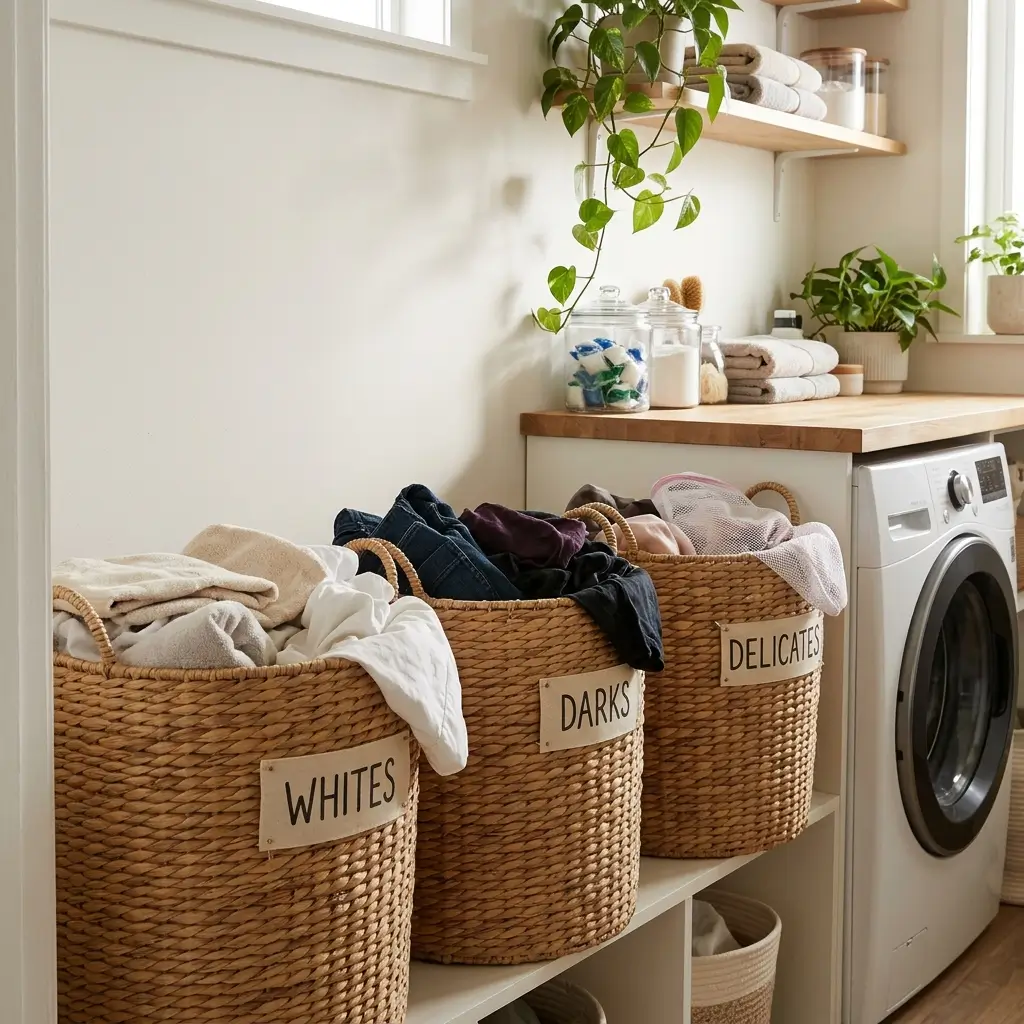
Laundry sorting becomes easier when every category has a designated basket. Instead of allowing dirty clothes to accumulate in one large pile, create separate containers for whites, darks, colors, and delicate garments.
For a small laundry room, look for slim, stackable, or collapsible laundry baskets. These options provide useful sorting space without occupying the entire floor.
If you have limited room, use a three-compartment laundry sorter that fits into a narrow corner.
How to make it work:
- Choose baskets that fit your available floor or shelf space.
- Label each compartment according to its purpose.
- Select breathable baskets if damp clothing may be placed inside.
- Empty and clean the baskets regularly.
Space-saving tip: Use a vertical laundry sorter with multiple compartments instead of three separate floor-standing hampers.
5. Install a Pegboard for Small Accessories
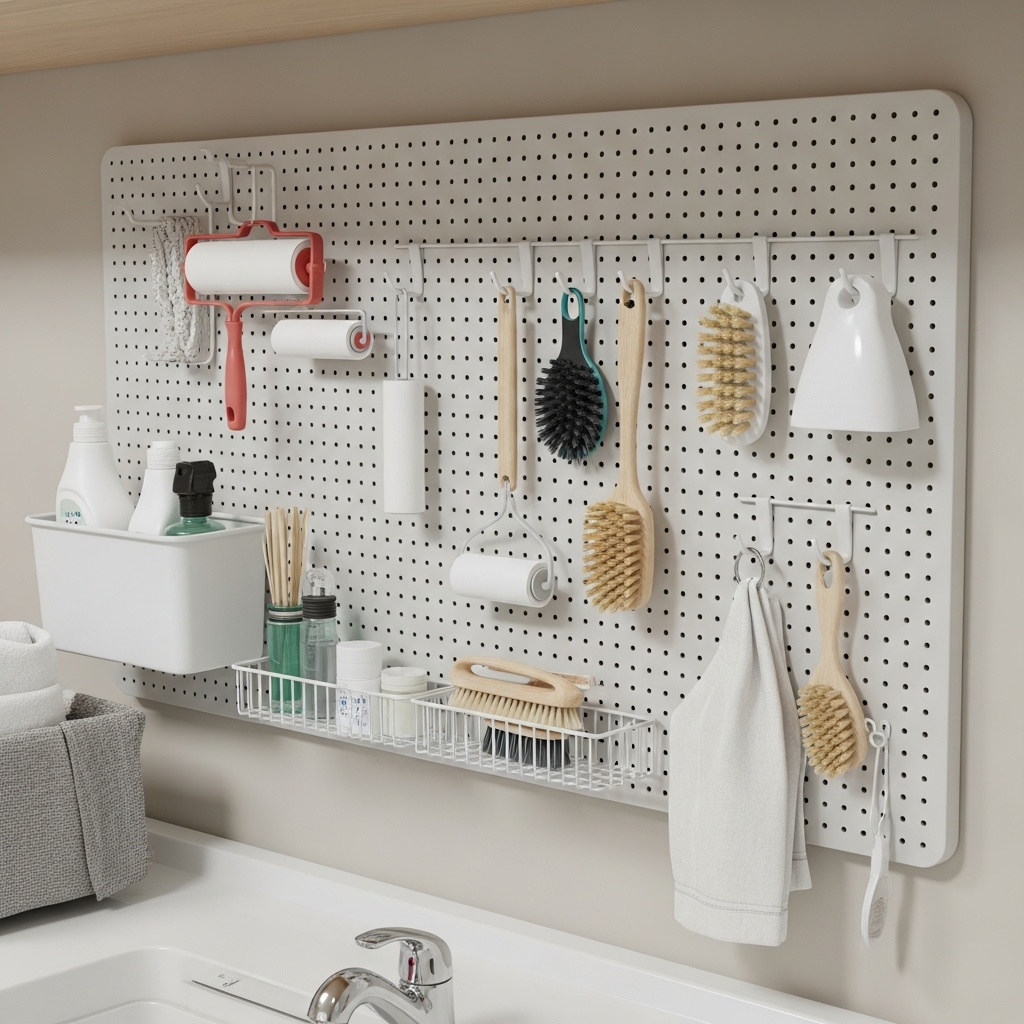
A pegboard is a versatile storage solution that helps organize small laundry accessories without filling your shelves and countertops.
Mount one on an available wall and use adjustable hooks, small baskets, and holders to store lint rollers, stain-removal brushes, measuring scoops, and other lightweight essentials.
One advantage of a pegboard is that you can rearrange the accessories whenever your storage needs change.
How to make it work:
- Select a pegboard that fits the available wall area.
- Secure it properly according to its material and installation requirements.
- Arrange frequently used accessories at eye level.
- Use small containers to prevent loose items from falling.
Space-saving tip: A narrow pegboard installed beside your washer or above a folding surface can provide useful storage without requiring additional cabinets.
6. Make Use of a Slim Rolling Storage Cart
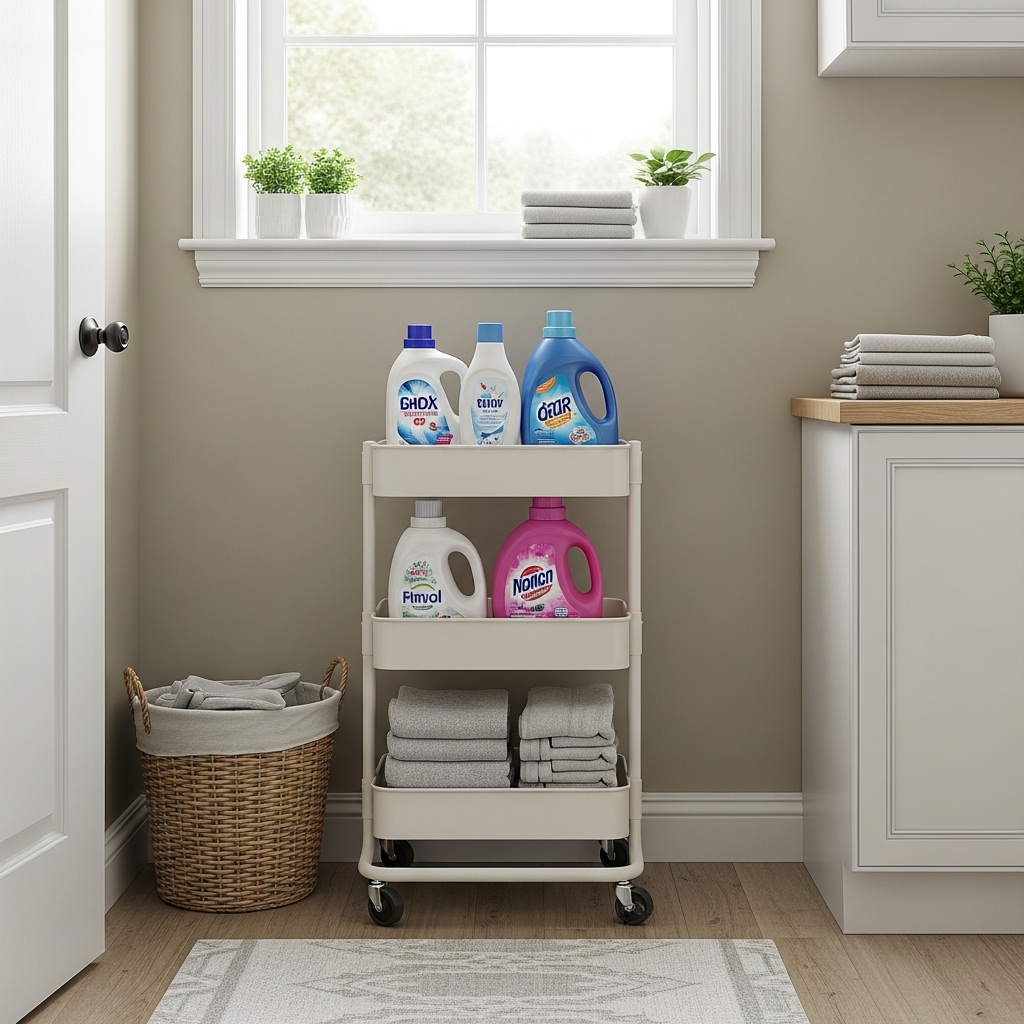
A rolling cart is especially useful in a laundry room with a narrow gap between appliances, cabinets, or walls.
Choose a slim, multi-tier cart that can slide into an otherwise unused space. Use its shelves to organize laundry accessories, cleaning cloths, and other appropriate household supplies.
The wheels allow you to pull the cart out whenever you need something and return it to its storage position afterward.
How to make it work:
- Measure the width and depth of the available gap before buying.
- Select a cart with locking wheels if stability is important.
- Use separate baskets or containers to organize smaller items.
- Avoid storing heavy or hazardous products in an unstable cart.
Space-saving tip: A three-tier rolling cart can turn an awkward gap into useful storage without requiring permanent cabinetry.
7. Add a Countertop Above Front-Loading Machines
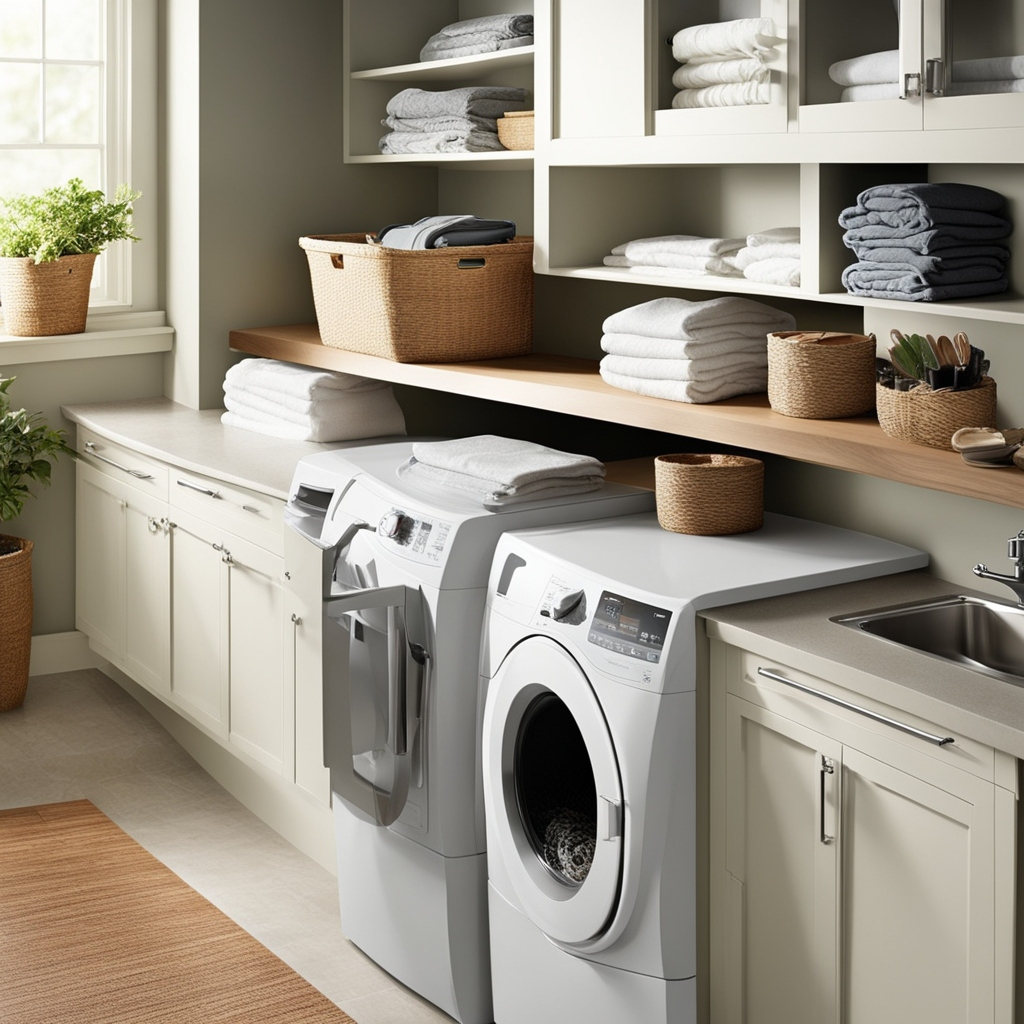
If your laundry room has front-loading washers and dryers installed side by side, a countertop above them can create a valuable work surface.
It provides a convenient place to fold clothes, sort clean laundry, or temporarily place an empty basket.
Materials such as laminate and properly finished wood can work well, provided they are suitable for the environment and installed correctly.
For a polished appearance, choose a countertop that complements your cabinets or wall colors.
How to make it work:
- Confirm that your appliances are suitable for an over-machine countertop installation.
- Measure the combined width and depth of the machines.
- Leave the manufacturer’s required access and service clearances.
- Secure the countertop independently rather than allowing it to interfere with the appliances.
- Avoid blocking controls, ventilation, or maintenance access.
Space-saving tip: Add a shallow shelf above the countertop for lightweight supplies, leaving the work surface free for folding.
8. Organize Laundry Accessories in Clear Containers
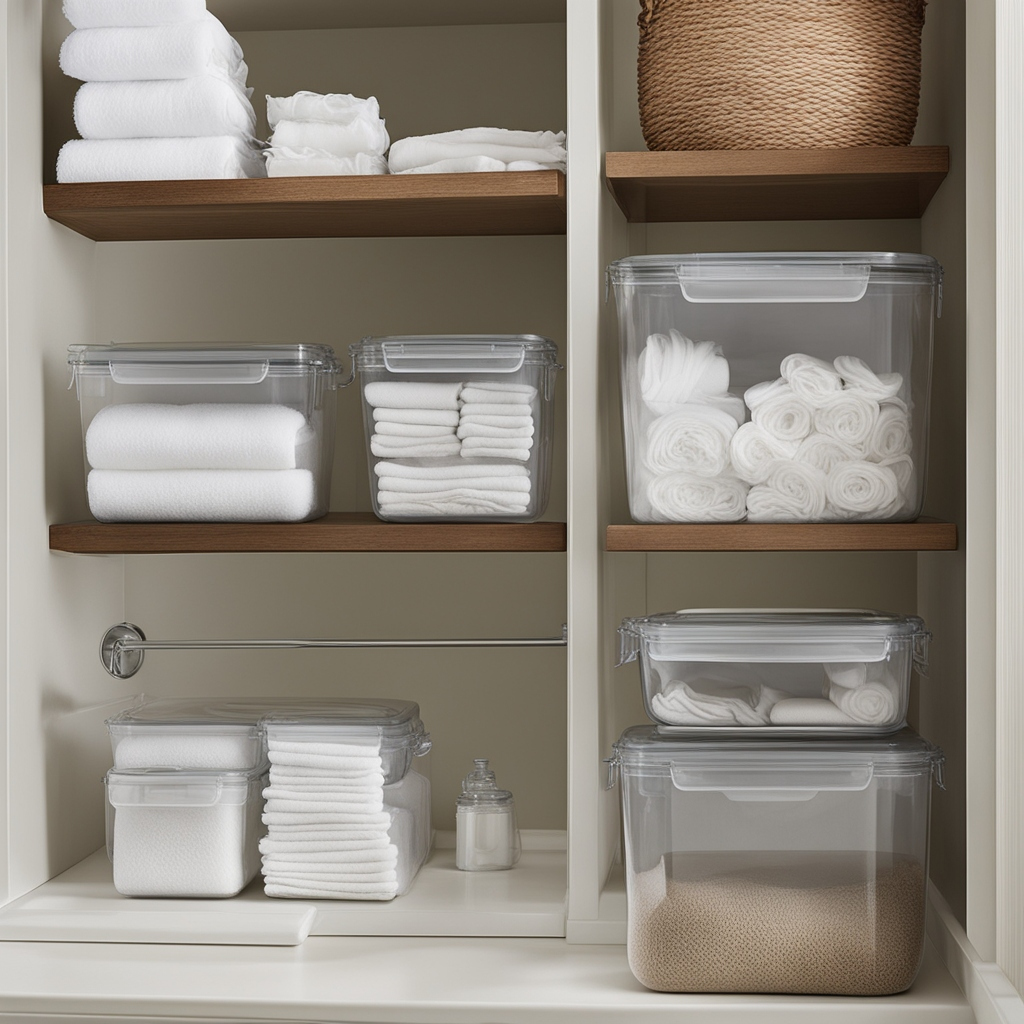
Clear storage containers can make laundry supplies easier to identify and organize. They are particularly useful for storing small accessories such as clothespins, lint rollers, stain-removal brushes, and dryer balls.
Choose matching containers to create a coordinated appearance on open shelves.
However, not every laundry product should be transferred into a clear container. Keep detergents, cleaning chemicals, and especially laundry detergent packets in their original labeled packaging. Store potentially hazardous products securely away from children.
How to make it work:
- Use transparent containers for suitable non-hazardous accessories.
- Label containers to identify their contents.
- Choose stackable designs to make better use of shelf height.
- Avoid overcrowding containers or making them difficult to reach.
Space-saving tip: Use small, stackable bins inside cabinets to separate laundry accessories and prevent loose items from getting mixed together.
9. Install a Hanging Rod for Clothes
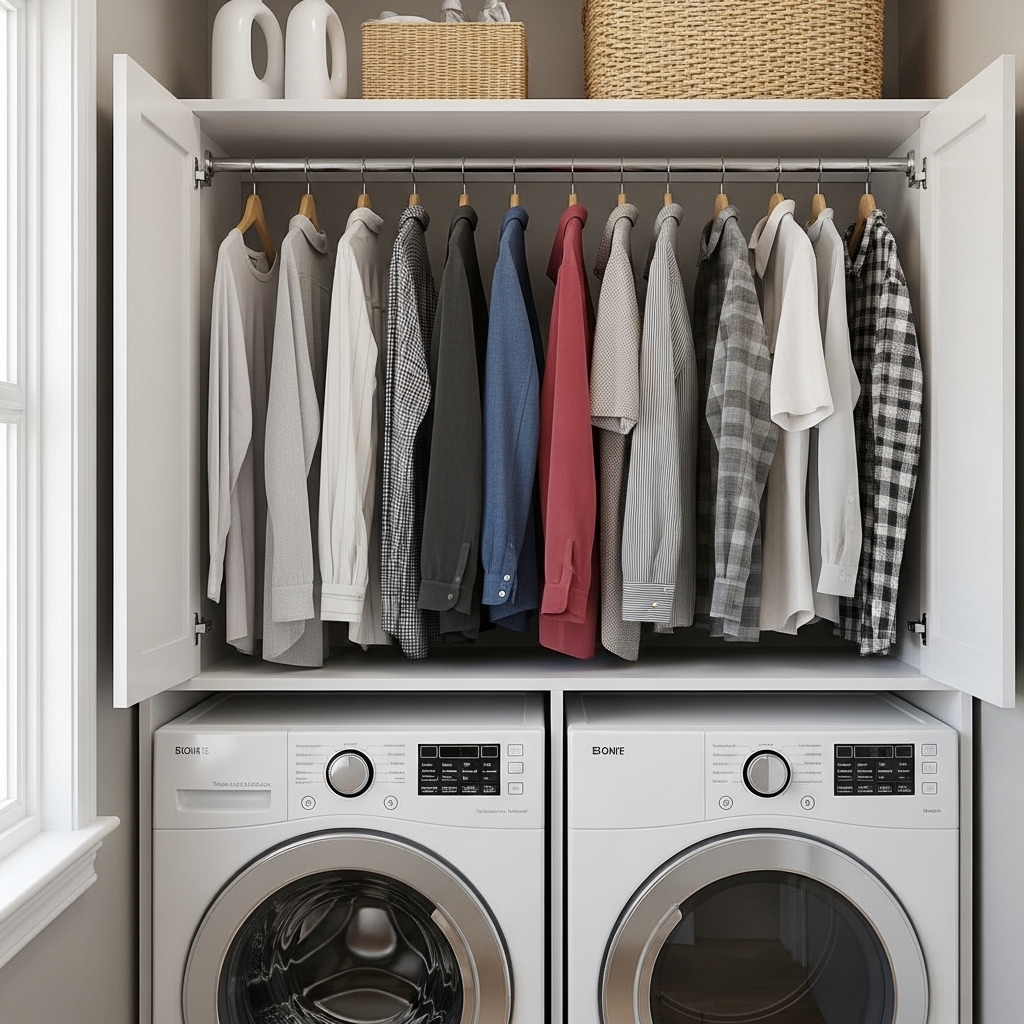
A hanging rod creates a convenient place to hang freshly washed shirts, dresses, uniforms, and delicate garments.
It can be installed between two cabinets, beneath a shelf, or in another suitable location where clothes have enough clearance.
This is particularly useful when you want to air-dry selected garments or hang clothes after removing them from the dryer.
How to make it work:
- Choose a rod that fits the available width.
- Use sturdy brackets and appropriate wall supports.
- Leave sufficient space for clothes to hang without touching appliances or walls.
- Avoid placing garments where they obstruct doors or walkways.
Space-saving tip: Position the rod directly beneath an existing shelf to combine hanging space and overhead storage.
10. Utilize the Back of the Laundry Room Door
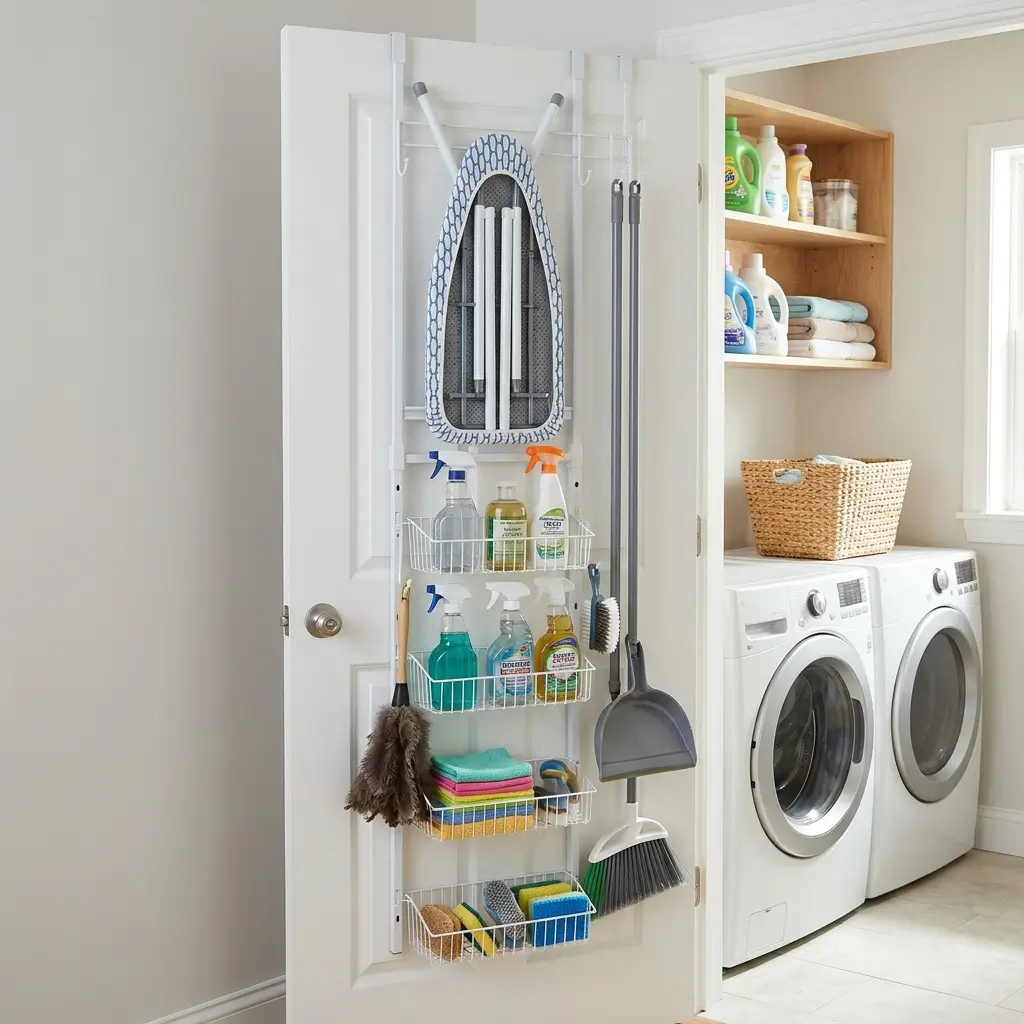
The back of a laundry room door is often overlooked when planning storage. However, it can provide useful space for lightweight accessories and cleaning tools.
Install an over-the-door organizer, hooks, or a suitable wall-mounted holder to keep smaller items off the floor.
Depending on the door’s construction and available clearance, you could use this space for laundry bags, cleaning cloths, and lightweight accessories.
How to make it work:
- Check that the organizer does not prevent the door from closing.
- Choose a design that fits the door’s thickness.
- Avoid overloading the door.
- Keep frequently used items within easy reach.
Space-saving tip: Use a slim over-the-door organizer with multiple compartments to store small laundry accessories without adding another cabinet.
11. Create a Compact Folding Station
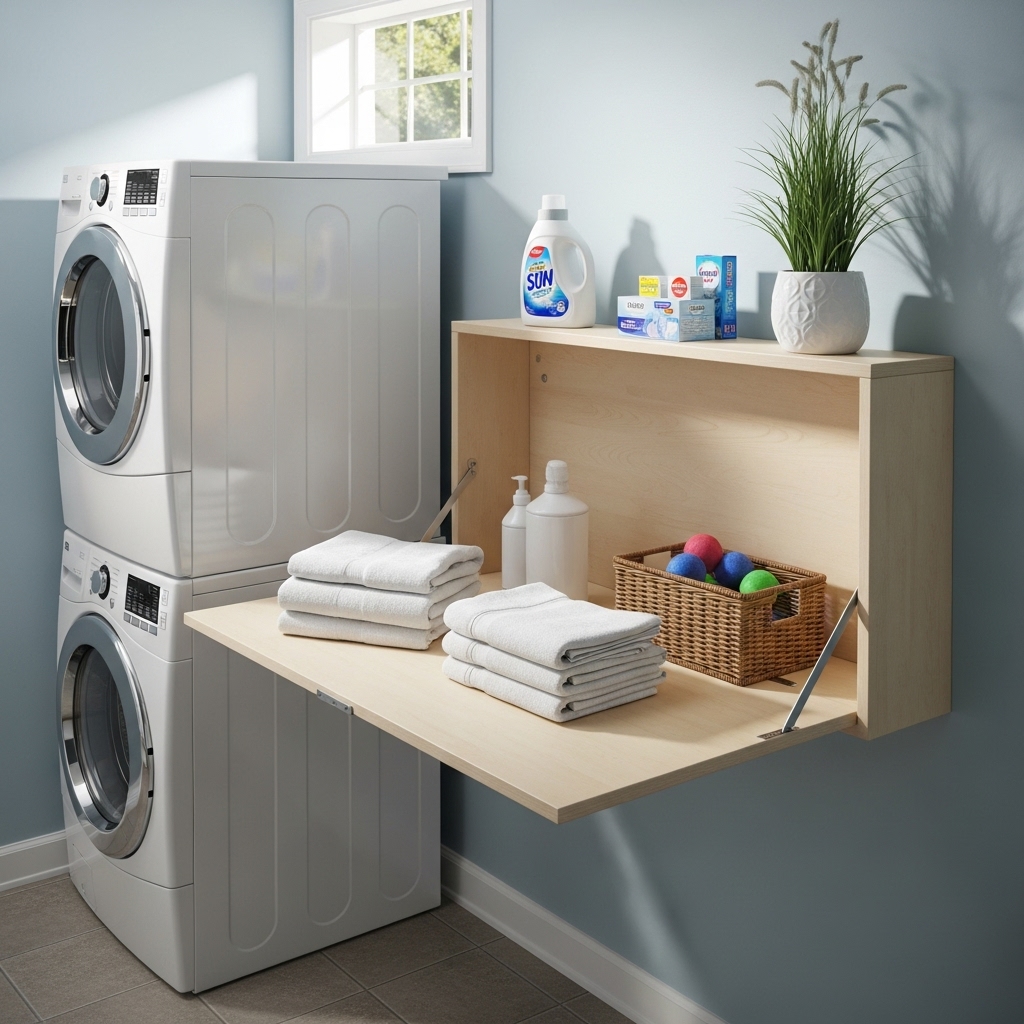
Folding clothes can become difficult when there is nowhere to place clean laundry. A dedicated folding station gives you a convenient workspace without requiring a large table.
If you have front-loading appliances, you may be able to use the countertop described earlier. Alternatively, install a wall-mounted folding table that folds away when not in use.
Another option is a small, narrow utility table that can double as a temporary sorting station.
How to make it work:
- Choose a folding surface that suits your available space.
- Keep the area free of unnecessary decorations and supplies.
- Use a nearby basket to collect folded clothes.
- Select a foldable design if the room has limited walking space.
Space-saving tip: A wall-mounted folding table is particularly useful in a narrow laundry room where a permanent table would obstruct movement.
12. Label Shelves, Baskets, and Storage Bins

Labeling bins, baskets, and shelves can make finding what you need much easier and keep the laundry room neat. Use a label maker or printable labels for a tidy look.
A well-organized laundry room should be easy to maintain, not just attractive immediately after cleaning.
Labels help everyone in the household understand where items belong. They also make it easier to identify laundry categories and locate frequently used supplies.
You can use adhesive labels, a label maker, chalkboard tags, or simple printable labels.
Useful labeling categories include:
- Whites
- Dark clothing
- Delicates
- Cleaning cloths
- Laundry accessories
- Spare supplies
- Ironing essentials
How to make it work:
- Use short, easy-to-read labels.
- Keep similar categories together.
- Apply waterproof labels where moisture is likely.
- Update labels whenever you change your storage arrangement.
Space-saving tip: Combine labeled bins with vertical shelving to create a storage system that is both accessible and easy to maintain.
13. Choose Compact or Stackable Laundry Appliances
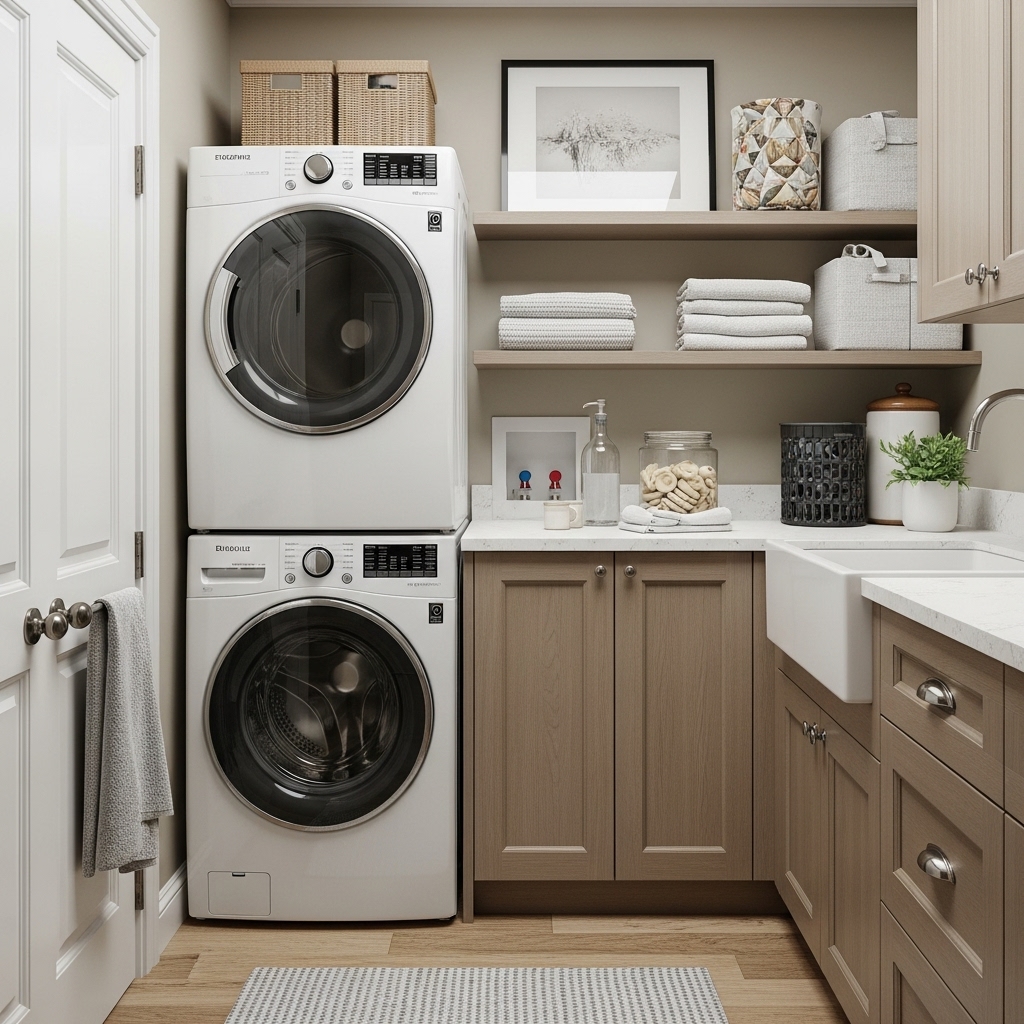
If your laundry room is extremely small, changing the appliance arrangement may create more usable space than adding storage accessories.
Stackable washer and dryer units are particularly useful when the room has more vertical than horizontal space. They allow you to position the appliances in a single footprint rather than side by side.
A compact washer, compact dryer, or washer-dryer combination may also be worth considering when replacing older appliances.
Before purchasing, measure the available space carefully. Consider appliance dimensions, door-opening clearance, plumbing connections, electrical requirements, and ventilation.
How to make it work:
- Check whether your particular washer and dryer models are approved for stacking.
- Use the manufacturer’s compatible stacking kit.
- Confirm the required installation clearances.
- Ensure that the floor and installation arrangement are suitable.
- Check access for future repairs and maintenance.
Space-saving tip: Stacking appliances can free up floor space for a narrow cabinet, laundry sorter, or rolling cart.
14. Use a Compact or Wall-Mounted Ironing Board
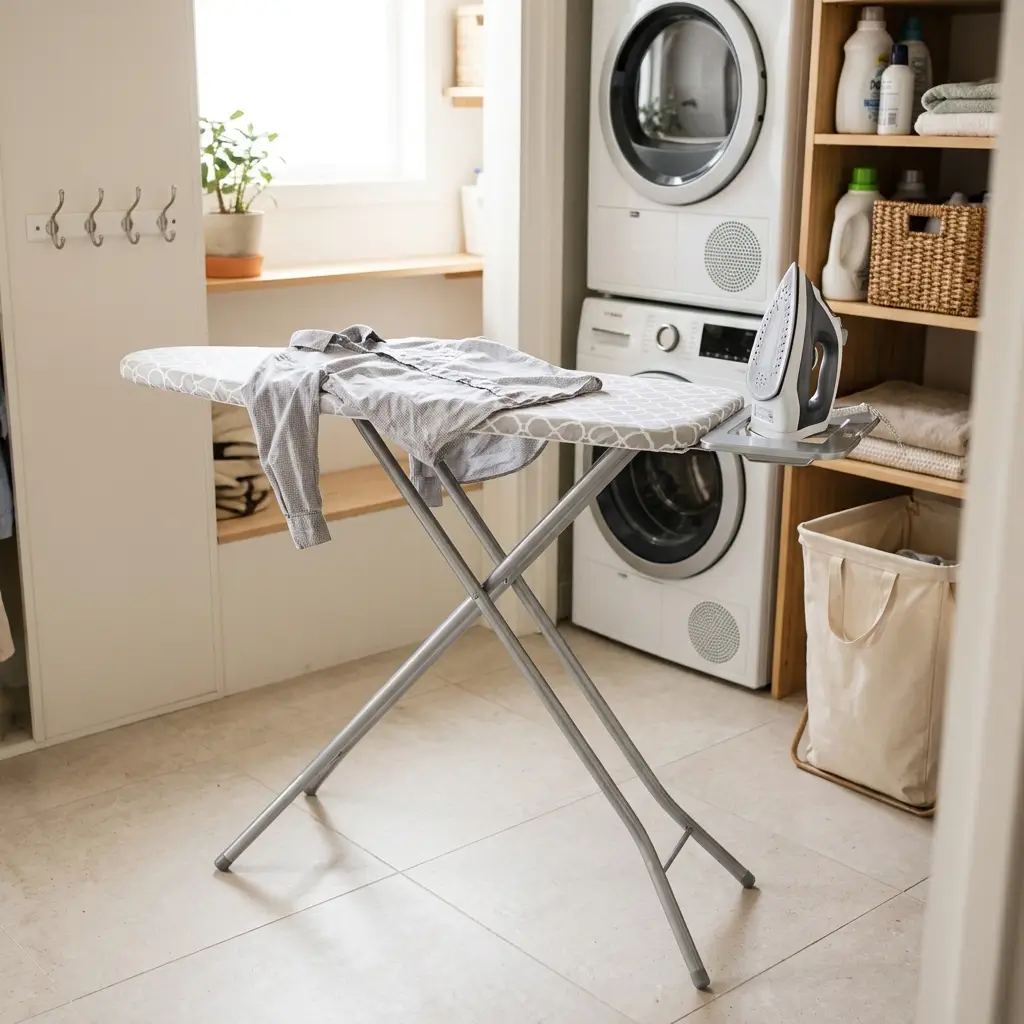
A full-size ironing board can be difficult to store in a small laundry room. A compact or wall-mounted alternative provides a practical solution.
Some models fold flat against the wall, while others fit inside a cabinet or attach to the back of a door.
Choose a design that offers a stable ironing surface and can be safely secured when stored.
How to make it work:
- Measure the available wall or cabinet space.
- Choose a suitable mounting system.
- Check the manufacturer’s weight and installation requirements.
- Allow enough room to open and use the board safely.
- Store the iron separately in an appropriate location after it has cooled.
Space-saving tip: A wall-mounted ironing board can eliminate the need for a separate floor-standing storage area.
15. Choose Multi-Functional Laundry Furniture
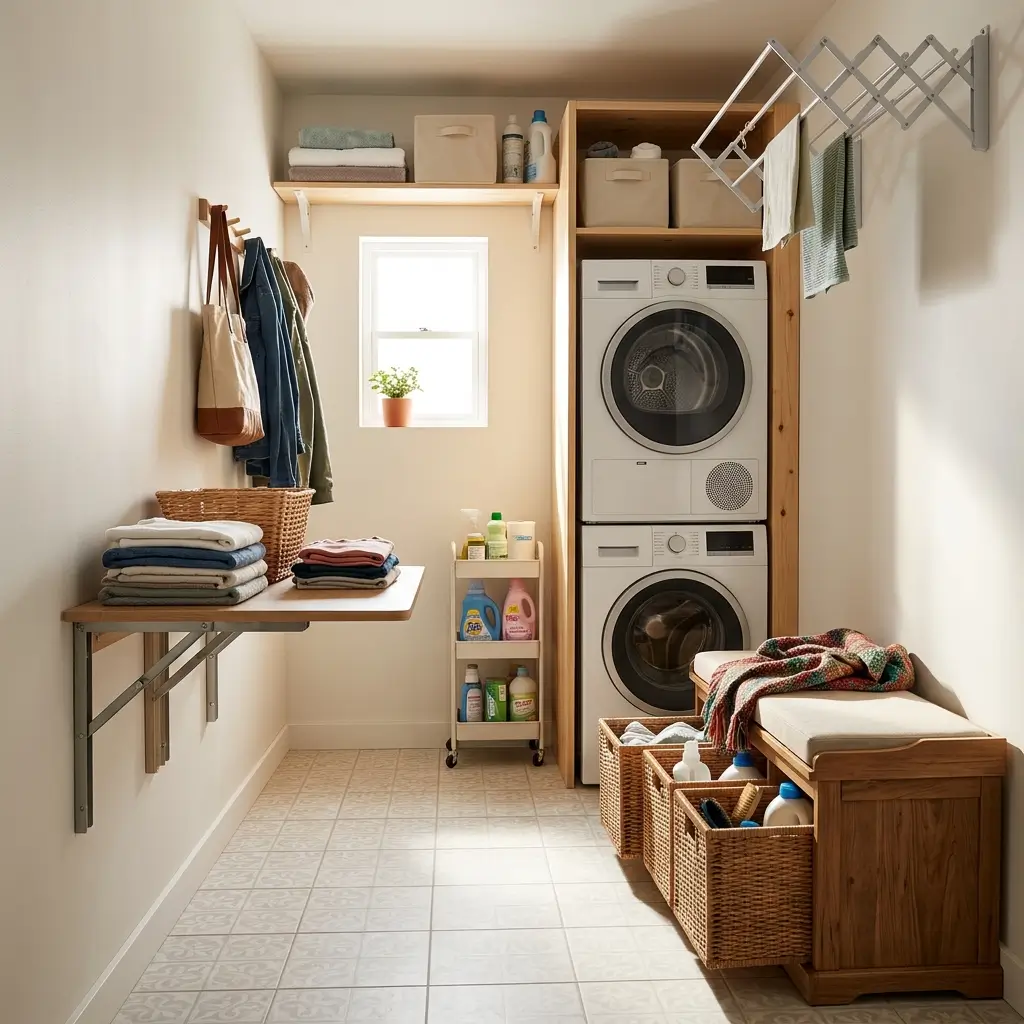
When every square inch matters, furniture that serves more than one purpose can be particularly useful.
Instead of purchasing several separate storage pieces, look for compact furniture that combines storage, workspace, and laundry organization.
For example, a narrow cabinet with a pull-out shelf can provide storage and a temporary work surface. A laundry sorter with an integrated countertop can offer both sorting compartments and a folding area.
Other useful options include:
- A storage bench with compartments for laundry accessories.
- A laundry cart with shelves and removable baskets.
- A foldable utility table that doubles as a sorting station.
- A compact cabinet with an integrated laundry hamper.
How to make it work:
- Choose furniture that fits your room’s dimensions.
- Prioritize pieces that solve more than one storage problem.
- Avoid bulky furniture that restricts movement.
- Select materials that are easy to clean and suitable for the room’s conditions.
Space-saving tip: Before purchasing new furniture, identify two functions you need most, such as laundry sorting and folding, and look for one piece that accommodates both.
Extra Tips for Keeping a Small Laundry Room Organized
Once you have introduced suitable storage solutions, a few simple habits can help prevent clutter from returning.
Keep Only Frequently Used Supplies Nearby
Store everyday laundry essentials in accessible locations. Move spare detergent, seasonal items, and less frequently used accessories into a separate storage area if space is limited.
Make Use of Awkward Corners
A narrow corner can accommodate a small hamper, slim shelving unit, or compact storage cabinet. Measure carefully to ensure that the addition does not obstruct appliance doors.
Keep Countertops Clear
Avoid turning your folding surface into a permanent storage area. Return supplies to their designated shelves or containers after each use.
Measure Before Buying Storage Products
A storage solution that looks attractive online may not fit your laundry room. Measure the width, height, and depth of the intended space before purchasing.
Prioritize Safety and Appliance Access
Never block dryer vents, appliance controls, electrical connections, or plumbing access with shelves and storage furniture. Follow the installation and clearance requirements for your particular appliances.
Keep laundry detergent packets and household cleaning chemicals in their original packaging and securely out of children’s reach.
Conclusion
A small laundry room can be both practical and attractive when every part of the space has a purpose. The key is to choose storage solutions that fit your room rather than trying to squeeze too many accessories into an already limited area.
Start with simple improvements such as wall shelves, hooks, laundry baskets, and a rolling cart. If you need more workspace, consider a countertop or fold-down folding station. For particularly narrow rooms, vertical storage and stackable appliances can make a noticeable difference.
You don’t have to implement all 15 ideas at once. Choose the solutions that address your biggest storage challenges, introduce them gradually, and maintain a designated place for every item.
With a thoughtful arrangement, even a tiny laundry area can become a more organized, convenient, and enjoyable part of your home.
Frequently Asked Questions
1. How do I organize a very small laundry room?
Start by removing items you rarely use and identifying the available storage areas. Install wall shelves, use hooks, choose slim laundry baskets, and consider a rolling cart for narrow gaps. Prioritize vertical storage to keep the floor as open as possible.
2. What is the best way to maximize space in a narrow laundry room?
Use stackable appliances where appropriate, wall-mounted drying racks, narrow storage carts, and slim cabinets. Keep the center of the room clear so you can move comfortably and access the machines.
3. How can I add storage above my washer and dryer?
Install sturdy wall shelves or cabinets above the appliances, provided the arrangement meets the manufacturer’s clearance and access requirements. Use the storage for suitable laundry accessories and lightweight supplies, keeping heavy items at a manageable height.
4. How can I create a folding area in a small laundry room?
A countertop above compatible front-loading machines is one option. You can also install a fold-down wall table or use a compact utility table that can be moved when necessary.
5. Are stackable washers and dryers suitable for small laundry rooms?
Yes. Stackable appliances can be useful when floor space is limited but vertical space is available. However, the specific models must be approved for stacking, and you should follow the manufacturer’s installation instructions and clearance requirements.
6. How do I keep laundry supplies organized in a small space?
Group similar items together using labeled baskets, cabinet organizers, and shelves. Keep frequently used supplies accessible and store spare items elsewhere when possible. Always keep laundry detergent packets and cleaning chemicals in their original packaging and securely away from children.
7. What can I put between my washer and dryer?
A slim rolling storage cart may fit into the gap between appliances, depending on their arrangement and the manufacturer’s clearance requirements. Measure the space carefully and ensure that the cart does not interfere with ventilation, movement, or appliance operation.
8. How can I make a small laundry room look less cluttered?
Use matching baskets, simple labels, coordinated storage containers, and closed cabinets to create a cleaner appearance. Keep countertops clear and avoid purchasing more organizers than you actually need.